
You're leaving the UK with RSUs or share options that haven't vested yet. A common assumption is that once you're non-UK resident, HMRC loses interest in anything that vests later. It doesn't. The UK taxes the part of the award that was earned while you were UK resident, even if the shares vest, or the option is exercised, after you've gone.
This guide covers two things only: how HMRC sources RSU and option income between grant and vest, and how the shares are taxed when you sell them.
The key question is simple. Over what period was the award earned, and how much of that period were you UK resident?
RSUs and share options: how they're taxed in the UK
What's the basic UK treatment? Both types of award create two separate tax points:
Restricted stock units (RSUs): income tax on the market value of the shares when they vest and are delivered to you. For UK purposes, RSUs are usually treated as share options, because they're a right to receive shares in the future.
Share options: income tax on the gain when you exercise, being the market value of the shares minus the price you pay for them.
When you sell: any growth after vesting or exercise is a capital gain, taxed separately from the income.
The income part is where leaving the UK makes a difference, because it's sourced back to the period in which the award was earned.
👉 HMRC guidance: Tax and Employee Share Schemes
Sourcing from grant to vest: the relevant period
How does HMRC decide how much is taxable in the UK? Since 6 April 2015, specific rules for internationally mobile employees apply. They treat the income as building up evenly over a "relevant period", which for RSUs and options runs from grant to vesting, or to exercise if that comes first.
The UK-taxable part is then broadly:
Taxable income = total income × (UK-taxable days in the relevant period ÷ total days in the relevant period)
Days while you were UK resident count in full.
Days after you became non-resident, including the overseas part of a split year, only count to the extent you worked in the UK on them.
👉 HMRC manual: internationally mobile employees and employment-related securities (ERSM160100)
Example: RSUs vesting after you leave
What does this look like in numbers? Take a straightforward three-year cliff vest.

Image 1 — sourcing the income from grant to vest
Alex is granted RSUs on 6 April 2024, vesting in full on 5 April 2027.
Alex is UK resident until 5 April 2026, then becomes non-resident from 6 April 2026, with no UK workdays afterwards.
The relevant period is 1,095 days, of which 730 were UK resident.
The shares are worth £90,000 when they vest.
£60,000 is taxable in the UK as employment income in 2026/27, even though Alex is non-resident that year. The remaining £30,000 is outside UK income tax.
What if Alex comes back to the UK for work?
UK workdays after leaving add to the UK share. Say Alex works 20 days in the UK out of 230 working days in 2026/27. The £30,000 attributable to that year is typically split on a workday basis, so around £2,609 more becomes UK-taxable. Keep a workday diary, because this is exactly what HMRC will ask for.
Share options: the fraction is fixed at vesting, the gain isn't
Does it matter when you exercise an option? For the fraction, no. The relevant period stops at vesting, so the UK percentage is locked in on that date. But the percentage is applied to the gain when you exercise.
If your option vests when you've been non-resident for a year and you exercise five years later, the UK still taxes its fraction of the full exercise gain. Any rise in the share price between vesting and exercise sits inside that charge. For options with long exercise windows, that can make the UK bill much larger than people expect.
Graded vesting: each tranche is separate
What if your award vests in stages? Each tranche has its own relevant period, from grant to that tranche's vesting date. With three annual tranches and a departure at the end of year two:
Tranche 1 vests after year one, while you're UK resident: 100% UK-taxable.
Tranche 2 vests on your last day of UK residence: 100% UK-taxable.
Tranche 3 vests a year after you've left: two-thirds UK-taxable.
This is why you can't take one blended percentage across a whole award. Your vesting schedule matters as much as your travel dates.
When grant to vest doesn't fit
Sometimes the grant-to-vest period doesn't reflect when the award was really earned. For example, an award might be granted for performance in the year before grant. The legislation includes a "just and reasonable" override so a different period can be used. It works both ways, and HMRC can use it too, so any departure from the default needs evidence behind it.
👉 HMRC manual: the just and reasonable override (ERSM162710)
Tax when you sell the shares
What happens when you eventually sell? Once RSUs have vested or an option has been exercised, you own ordinary shares. Any growth from then on is a capital gain, not employment income.
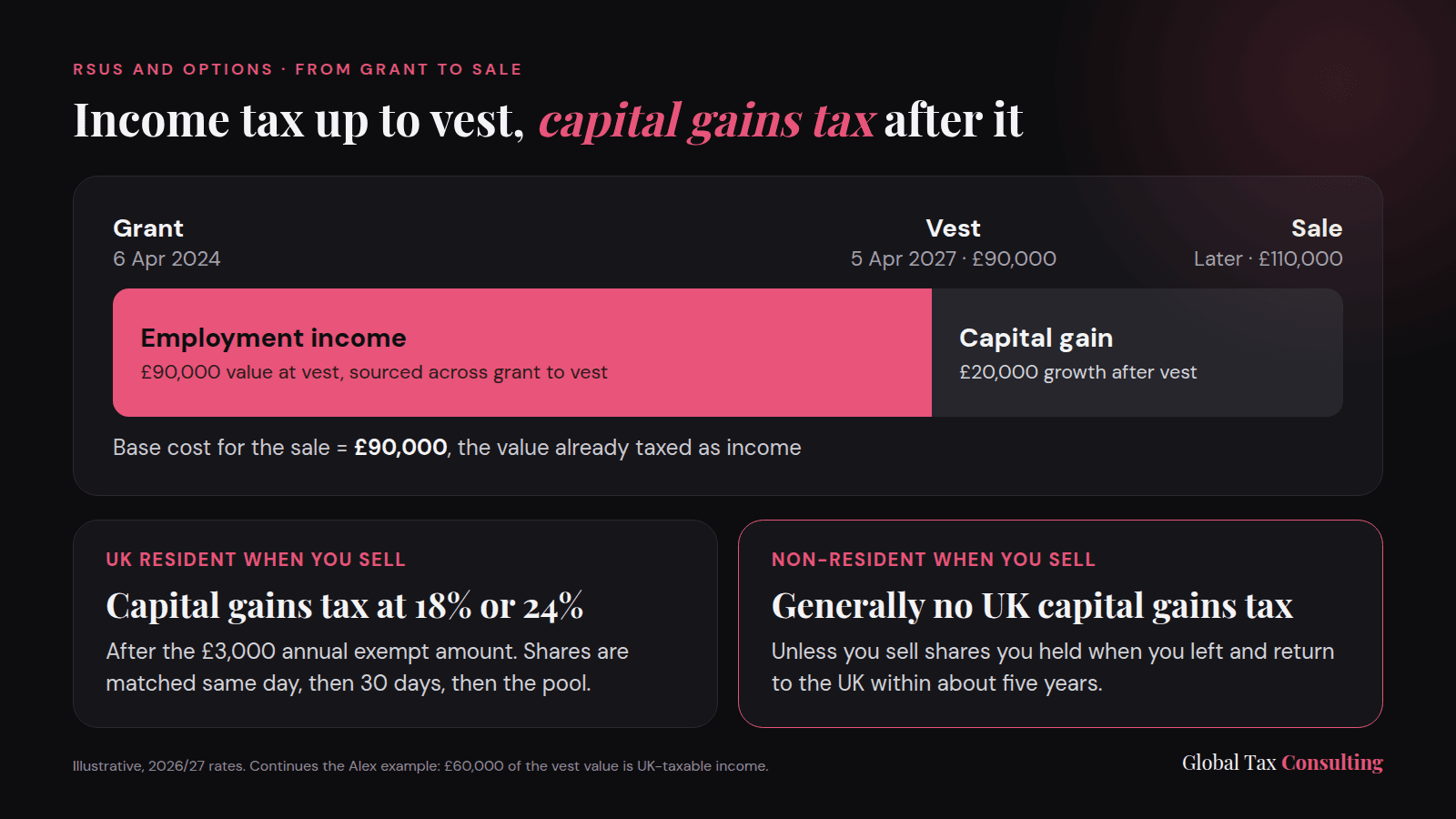
Image 2 — income tax up to vest, capital gains tax after it
Stage or status | UK tax treatment |
|---|---|
Grant (6 April 2024) to vest (5 April 2027, worth £90,000) | Employment income: the £90,000 value at vest, sourced across grant to vest |
Vest to sale (later, for £110,000) | Capital gain: £20,000 growth after vest. The base cost for the sale is £90,000, the value already taxed as income. |
UK resident when you sell | Capital gains tax at 18% or 24%, after the £3,000 annual exempt amount. Shares are matched same day, then 30 days, then the pool. |
Non-resident when you sell | Generally no UK capital gains tax, unless you sell shares you held when you left and return to the UK within about five years. |
Your base cost is the market value of the shares when they vested or when you exercised, which is the amount taxed as income plus anything you paid. That's why selling immediately at vest, including the "sell to cover" shares your employer sells to pay the tax, usually produces little or no gain.
If you're UK resident when you sell
Capital gains tax applies at 18% or 24%, depending on your income, after the £3,000 annual exempt amount.
Shares in the same company are matched in a set order: shares bought the same day, then within the next 30 days, then your pooled holding at average cost. Multiple vests can mean a blended base cost.
In the year you leave, if split-year treatment applies, gains on sales made in the overseas part of the year are generally outside UK capital gains tax.
👉 HMRC guidance: Tax when you sell shares
If you're non-resident when you sell
Most non-residents aren't liable to UK capital gains tax on shares. In the Alex example, if the shares worth £90,000 at vest are sold for £110,000 while Alex is non-resident, the £20,000 gain is outside UK capital gains tax.
The main exception is the five-year rule. If you sell shares you already held when you left, and you return to the UK within about five years, the gain can be taxed in the year you come back. See our guide to the temporary non-residence rules.
Checklist before you leave
Get your grant documents and vesting schedule for every RSU and option award, tranche by tranche.
Pin down your residence position for the year you leave, including whether split-year treatment applies. See split-year treatment.
Work out the UK fraction for each tranche using your departure date and grant-to-vest periods.
Keep a workday diary for any UK work after you leave.
Record the market value at every vest and exercise. It's your base cost when you sell.
Think about when you sell, particularly shares you already hold and a possible return within five years.
Cash bonuses follow a similar "when was it earned" logic. See the bonus examples in working remotely abroad for a UK company.
Frequently asked questions
Do I pay UK tax on RSUs that vest after I leave the UK?
Usually yes, on part of them. HMRC taxes the proportion of the value relating to the time between grant and vesting when you were UK resident or working in the UK. The rest is outside UK income tax.
What is the relevant period for RSUs and share options?
It's normally the period from grant to vesting, or to exercise if that comes first. Where an award vests in tranches, each tranche has its own relevant period.
Does it matter when I exercise my option after leaving the UK?
The UK percentage is fixed at vesting, but it's applied to the gain on the date you exercise. Exercising later means the UK taxes its share of any extra growth between vesting and exercise.
What is my base cost when I sell RSU shares?
Your base cost is the market value of the shares when they vested, which is the amount taxed as income. For options, it's the market value at exercise. Only growth after that point is a capital gain.
Do I pay UK capital gains tax on RSU shares if I sell after leaving the UK?
Generally not, if you're non-UK resident when you sell. The main exception is shares you held when you left, if you return to the UK within about five years.
work with GTC
Get your position confirmed in writing
Global Tax Consulting advises internationally mobile individuals on residency reviews, UK tax planning and tax return preparation. Tell us where you are and what you earn, and you will have a fixed fee and a clear view of your UK tax position.
⭐ 5★ rated