
Capital gains tax on your main residence is normally nil, because Private Residence Relief exempts the gain for the time you lived there. Move abroad and that changes. You keep relief for the years the property was your home and for the final 9 months you own it, but most of your time overseas stops counting.
How much tax you pay depends on when you sell, where you're resident at the time, and whether you ever move back in. This guide explains how Private Residence Relief (also called principal private residence relief) works, the 90-day rule for non-residents, the April 2015 rebasing, the absence reliefs and the reporting rules, with two worked examples.
If you'd like this checked for your own situation, see our capital gains tax advice for non-residents.
Capital gains tax on main residence sales: how the relief works
How is the relief worked out? Private Residence Relief exempts a fraction of your gain: the time the property was your only or main residence, divided by the time you owned it. If you lived there throughout, the whole gain is exempt.
Three kinds of period count:
Actual occupation. Time the property was your home.
The final 9 months of ownership. These always count if the property was your main residence at some point. The period is 36 months if you or your spouse or civil partner are disabled or in long-term care and have no other home that could qualify.
Qualifying absences. Certain periods away are treated as occupation, on strict conditions covered below.
Gardens and grounds are included up to 0.5 hectares, or more if the house reasonably needs it.
👉 Legislation: Taxation of Chargeable Gains Act 1992, section 223 (amount of relief)
👉 HMRC helpsheet: HS283 Private Residence Relief
Private Residence Relief for non-residents: the 90-day rule
Can a non-resident claim Private Residence Relief? Yes, but since 6 April 2015 there has been an extra test. Your UK home is treated as not occupied for a tax year if neither you nor your spouse or civil partner is UK resident that year and you don't meet the day count test.
The day count test:
90 days in the tax year. A day counts if you're in the home at midnight.
Your spouse's days count. A night spent there by your spouse or civil partner counts as yours, but no night is counted twice.
Other UK homes count too. Nights in any other UK home you or your spouse have an interest in are added in.
Part years are scaled down. If you own the home for only part of a tax year, the 90 days are reduced in proportion and rounded up.
Meeting the test only makes the year eligible. The home must still be your main residence and, as you'll also have a home abroad, that usually means nominating it on your return.
Ninety nights in a UK home can make you UK resident again, so check the Statutory Residence Test first.
👉 Legislation: Taxation of Chargeable Gains Act 1992, section 222B (non-qualifying tax years)
👉 HMRC manual: CG64582 Residences in another territory: day count
Which periods of absence still count?
Do your years abroad ever count as occupation? They can. Three absence reliefs treat time away as time in the home, and they override the 90-day rule when their conditions are met.
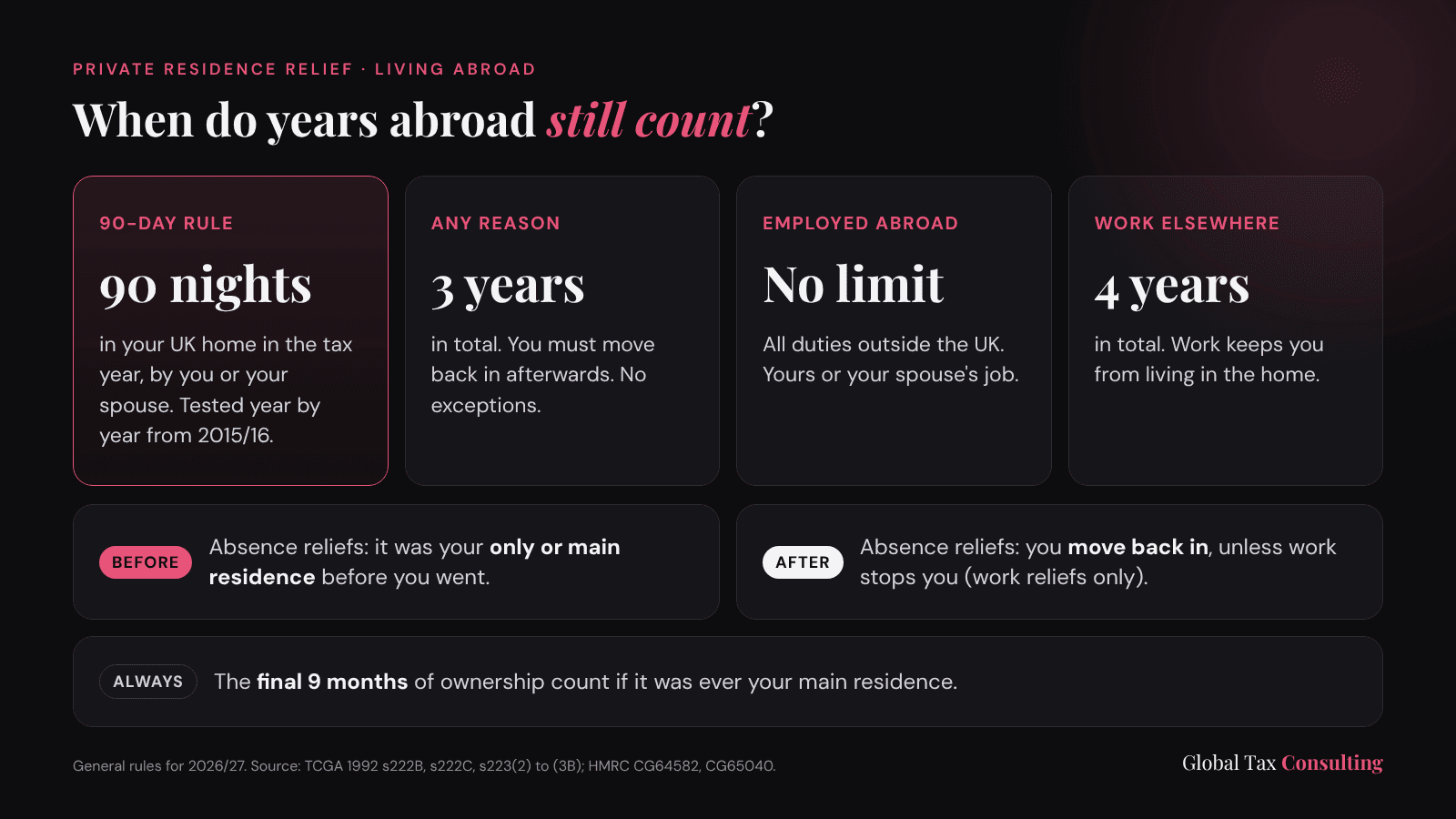
Image 1 — The 90-day rule and absence reliefs at a glance
Absence reliefs at a glance
Reason for absence | Maximum | Must you move back in? |
|---|---|---|
Any reason | 3 years in total | Yes, always |
Employed abroad, all duties outside the UK | No limit | Yes, unless your work prevents it |
Work elsewhere, or employer requires you to live elsewhere | 4 years in total | Yes, unless your work prevents it |
The two work-related reliefs also cover you if you lived with a spouse or civil partner who had the job. In every case the property must have been your only or main residence before the absence.
For expats, the reliefs often fail, usually because:
You never move back in. Selling from abroad, or returning and choosing to live elsewhere, loses the relief. The final 9 months don't count as moving back. If you're still non-resident when you move back in, that year must itself pass the 90-day rule.
You weren't an employee. The unlimited relief is for an employment or office. Self-employed people may have the 4-year work relief as well as the 3-year relief; retirees have only the 3-year relief.
You did some work in the UK. All the duties must be performed outside the UK, and HMRC's manual says even incidental UK duties count.
If you left before 6 April 2015 and sell as a non-resident, your earlier time in the home only counts as the "before" if you elect for that on the return. Your years away before April 2015 then count towards the limits.
👉 HMRC manual: CG65040 Private residence relief: periods of absence
Selling your UK home while living abroad
What is taxed if you sell as a non-resident? Only the gain since 5 April 2015, if you owned the home before then. This is called rebasing. You can instead elect for straight-line time apportionment or for the whole gain since purchase, and that choice changes the relief.
Rebasing and time apportionment. For relief, your period of ownership starts on 6 April 2015, so years you lived there before then don't go into the fraction.
Whole gain. Your full ownership and occupation history counts, but so does the full gain.
Our guide to non-resident capital gains tax on UK property covers the methods, costs and losses.
Example 1: Daniel sells from Portugal
Daniel bought his home on 6 July 2011 for £244,000 including costs and lived there until he left the UK on 5 July 2019.
He hasn't spent 90 nights there in any later tax year and never moves back.
The home was worth £340,000 on 5 April 2015. He completes the sale on 5 July 2026 for £484,000 after selling costs.
Gain since April 2015: £484,000 less £340,000 = £144,000.
Ownership counted: 6 April 2015 to 5 July 2026 = 135 months.
Relieved: 51 months lived there plus the final 9 months = 60 months.
Relief: £144,000 x 60/135 = £64,000. Gain left: £80,000.
After the £3,000 annual exempt amount, £77,000 is taxable. At 24% that is £18,480, or less if part of his basic rate band is unused.

Image 2 — Which months count for relief in Daniel's example
Period | Where Daniel lived | Counts for relief? |
|---|---|---|
July 2011 to 5 April 2015 | Lived in the home | Outside the calculation |
6 April 2015 to 5 July 2019 | Lived in the home | 51 months, relieved |
6 July 2019 to 5 October 2025 | Living in Portugal | 75 months, not relieved |
To 5 July 2026 | Final 9 months of ownership | 9 months, relieved |
Ownership counted from 6 April 2015 is 135 months, and 51 + 9 = 60 months are relieved. The gain since April 2015 is £144,000 (£484,000 less £340,000). Private Residence Relief is £144,000 × 60/135 = £64,000, leaving a gain of £80,000 and a taxable gain of £77,000 after the £3,000 exempt amount.
Daniel's three methods compared
Method | Gain before relief | Relief fraction | Gain left |
|---|---|---|---|
Rebasing to April 2015 | £144,000 | 60/135 | £80,000 |
Time apportionment | £180,000 | 60/135 | £100,000 |
Whole gain | £240,000 | 105/180 | £100,000 |
Rebasing wins for Daniel, but not for everyone. Test your own numbers (ours are to the nearest month) in our non-resident capital gains tax calculator.
👉 GOV.UK: Work out your tax if you're a non-resident selling UK property or land
👉 HMRC manual: CG65070 Periods away from property: specific points for NRCGT
Capital gains tax on a former main residence after you return
Is it better to sell after you come back? Sometimes. A UK resident is taxed on the whole gain since purchase, with no April 2015 rebasing. But your whole occupation history counts, and moving back in can switch on an absence relief.
Example 2: Aisha and Tom move back in
Aisha and Tom, who are married, bought their home jointly on 1 July 2014 and lived there until 30 September 2019 (63 months).
Tom then took a job in Singapore with all duties performed there, and Aisha lived with him. They were away from 1 October 2019 to 30 September 2025 (72 months).
They moved back in on 1 October 2025, made it their home again, and sold as UK residents on 30 June 2026 (9 months) at a gain of £240,000.
All 144 months count: 63 lived there, 72 under the working abroad relief, and 9 back in the home. The whole gain is exempt.
Had they returned but never moved back in, only 63 months plus the final 9 would count. That is 72/144, leaving £120,000 chargeable, or £60,000 each. After the £3,000 exempt amount, that is up to £13,680 of tax each at 24%.
An absence relief treats the UK house as a residence, not automatically the main one. A flat rented abroad under a tenancy is also a residence, so Aisha and Tom should nominate the UK house. A late nomination is allowed where the other home has negligible capital value, as a flat rented at a market rent usually does.
Two homes, couples and letting the property
What if you have more than one home? You can nominate your main residence within 2 years of each change in your combination of homes. Without a nomination, it is decided on the facts.
Non-residents nominate on the return. If you sell as a non-resident, you nominate in the 60-day return for that sale, and it can't be changed afterwards.
Couples have one main residence. Spouses and civil partners living together share a single main residence. A nomination needs both of you, in writing if only one of you files the return.
Transfers between spouses carry the history. If you're living together when one of you transfers the home to the other, the new owner takes over the other's period of ownership and occupation.
Letting the whole home earns nothing extra. Since 6 April 2020, lettings relief of up to £40,000 only applies where you lived in the home at the same time as your tenant. Rent is taxed separately under the non-resident landlord scheme.
Job-related accommodation can protect a home. While you live in accommodation that goes with your job, a house you intend to make your main residence is treated as occupied.
Does it matter which tax year you sell in?
Is the year you leave treated differently? Yes. You're normally still UK resident for that tax year, so the 90-day rule doesn't apply to it. And if you sell within 9 months of moving out, the final period normally covers the gap.
A sale in the overseas part of a split year falls under the non-resident rules, so it needs a 60-day return even with no tax due. See split-year treatment.
The gain since April 2015 is taxed in the year of sale. But if you return within five years, the gain that rebasing left out is likely to be charged in the year you return. See the temporary non-residence rules.
👉 HMRC helpsheet: HS307 Non-resident Capital Gains for UK land and property
Reporting the sale and the 2026/27 rates
Do you have to tell HMRC if the relief covers everything? If you're non-resident, yes. You must report the sale within 60 days of completion even with no tax to pay or a loss. UK residents only file a 60-day return where tax is due.
For 2026/27, gains are taxed at 18% within your unused basic rate band and 24% above it, after the £3,000 annual exempt amount. Our guide on how to report capital gains tax on UK property walks through the return.
👉 GOV.UK: Tell HMRC about Capital Gains Tax on UK property or land if you're not a UK resident
Common mistakes with Private Residence Relief when you live abroad
Assuming a former home is always exempt. Years abroad drop out unless the 90-day rule or an absence relief brings them back in.
Relying on an absence relief without moving back in. Ten years working abroad protects nothing if you sell from overseas by choice.
Chasing 90 nights without checking residence. The nights that rescue a tax year for relief can also make you UK resident.
Skipping the 60-day return because no tax is due. Non-residents must file anyway, and it's where nominations and elections are made.
Selling without an April 2015 valuation. Rebasing needs a 5 April 2015 market value you can support if HMRC asks.
Frequently asked questions
Do I pay capital gains tax on my main residence if I live abroad?
Possibly. Non-residents pay UK capital gains tax on UK homes, normally on the gain since 5 April 2015. Private Residence Relief covers the time you lived there and the final 9 months, so a sale soon after leaving is often tax-free.
What is the 90-day rule for Private Residence Relief?
From 6 April 2015, a tax year in which neither you nor your spouse or civil partner is UK resident only counts for relief if you spend at least 90 midnights in your UK home that year. Your spouse's nights count too.
How long can I live abroad before I lose Private Residence Relief?
The final 9 months of ownership always qualify if the property was once your main residence. Beyond that, time abroad only counts if you meet the 90-day rule or an absence relief, such as up to 3 years for any reason or any period employed abroad. Absence reliefs normally require you to move back in.
Can I avoid capital gains tax by moving back into my old home?
Moving back in can bring qualifying absences into the relief, but only if the property becomes your home again. HMRC looks at the quality of your occupation, not its length, so a brief stay before a sale is unlikely to be accepted.
Do I need to report the sale if Private Residence Relief covers the whole gain?
If you're not UK resident, yes. You must report the sale to HMRC within 60 days of completion even with no tax to pay. UK residents only need the 60-day return when tax is due.
work with GTC
Get your position confirmed in writing
Global Tax Consulting advises internationally mobile individuals on residency reviews, UK tax planning and tax return preparation. Tell us where you are and what you earn, and you will have a fixed fee and a clear view of your UK tax position.
⭐ 5★ rated