
This returning to the UK tax guide for 2026/27 covers residence, split years, the five-year and ten-year rules, overseas assets, pensions, National Insurance and Self Assessment.
If you'd like this checked for your own situation, see how we help people moving back to the UK.
When you become UK resident again
When are you UK tax resident again? When you meet the Statutory Residence Test for a tax year. It has three steps:
Automatic overseas tests. You stay non-resident if you spend fewer than 46 days in the UK and weren't resident in any of the previous three tax years (fewer than 16 days if you were).
Automatic UK tests. You're resident if you spend 183 days or more in the UK, if your only home is in the UK, or if you work full-time in the UK over a 365-day period.
Sufficient ties test. Otherwise, your UK days are set against your UK ties: family, accommodation, work and the 90-day tie.
If you weren't resident in any of the previous three tax years you count as an arriver, with the more generous table. If you were resident in any of them, a stricter table applies from 16 days.
Sufficient ties for arrivers
Days in the UK in the tax year | UK ties that make you resident |
|---|---|
46 to 90 | All 4 |
91 to 120 | At least 3 |
More than 120 | At least 2 |
Residence is for the whole tax year unless a split year applies. Once you're UK tax resident again, worldwide income and gains are taxed as they arise. The remittance basis ended on 6 April 2025.
👉 GOV.UK: Guidance note for the Statutory Residence Test (RDR3)
Split-year treatment on arrival
Are you taxed from 6 April or from the day you arrive? If you meet one of five arrival cases, the tax year is split into an overseas part, taxed for most purposes as if you were non-resident, and a UK part:
Case 4: your only home starts to be in the UK.
Case 5: you start full-time work in the UK.
Case 6: you stop full-time work overseas.
Case 7: your partner qualifies under Case 6.
Case 8: you start to have a home in the UK.
It isn't a choice. Every case requires you to have been non-resident in the previous tax year, and each has further conditions. Your landing date doesn't set the split. Under Case 4 the UK part starts when your only home is in the UK, under Case 5 when the work starts, and under Case 8 when you first have a UK home.
In the overseas part, foreign income and gains on overseas assets generally aren't taxed, but UK income and UK property gains still are. A split year doesn't change your residence under a tax treaty, so if another country still treats you as resident, see dual tax residency. The conditions are in our guide to split-year treatment.
👉 HMRC manual: RFIG21030 When split year treatment will apply

Image 1 — How long you were away decides which rules apply
The temporary non-residence rule
What if you come back within five years? The temporary non-residence rule applies if you were UK resident in at least four of the seven tax years before you left and you're away for five years or less. The period is measured in actual time, not tax years. To escape it you need five years and a day.
👉 HMRC manual: RFIG21510 Temporary non-residence: introduction
If you're caught, these are taxed in the year you return:
Gains: on assets you owned before you left and sold while away.
Close company dividends: from a company you had a material stake in. For anyone becoming resident again on or after 6 April 2026, this includes profits earned after you left.
Pension withdrawals: flexible withdrawals totalling more than £100,000, and certain lump sums.
Other items: gains on life insurance bonds and offshore income gains.
Salary earned abroad isn't caught, and nor, normally, are gains on assets you bought while away. Foreign tax on the same gain or dividend can usually be credited.
Worked example: back just inside five years
Priya left on 1 September 2021 with a split year, after ten years of UK residence. In 2023 she sold shares she already owned for a £100,000 gain.
If her UK residence restarts on 1 August 2026, she was away 4 years 11 months. The gain is taxed in 2026/27: £100,000 less the £3,000 annual exempt amount is £97,000, which at the higher 24% rate is £23,280.
If it restarts on 1 October 2026, she was away 5 years 1 month and the gain stays outside UK tax.
Without a split year on return, she'd be resident from 6 April 2026, away only 4 years 7 months.
👉 HMRC helpsheet: HS278 Temporary non-residents and Capital Gains Tax
The FIG regime if you were away ten years
Can a British citizen use the FIG regime? Yes. There's no domicile or nationality test. You qualify if you weren't UK resident in any of the ten tax years before the year you return. The FIG regime then relieves foreign income and gains from UK tax for your first four tax years of residence.
The four years run in a row. The year you arrive is year one, even if it's a split year. Arrive in 2026/27 and the window ends on 5 April 2030.
You must claim. Each year, on your tax return, with the amounts of foreign income and gains stated. The deadline for 2026/27 is 31 January 2029.
A claim has a cost. You lose your personal allowance and capital gains annual exempt amount for that year.
Overseas Workday Relief works alongside it for employees with duties abroad. It's capped at the lower of 30% of qualifying employment income and £300,000 a year.
Ten consecutive tax years of non-residence also reset the inheritance tax clock. Overseas assets come into scope once you've been UK resident for at least ten of the previous 20 tax years, and after a reset only the year you return and later years count. Former remittance basis users should also look at the Temporary Repatriation Facility.
How long were you away?
Time away | Regime | What it means |
|---|---|---|
Five years or less | Temporary non-residence | Some gains and income from abroad taxed in the year you return |
More than five years, fewer than ten full tax years | Ordinary resident rules | Worldwide income and gains taxed from the date residence starts |
Ten full tax years or more | FIG regime | Four years of relief on foreign income and gains, if claimed |
The five-year rule runs in actual time. The ten-year rule counts complete tax years of non-residence.
👉 HMRC helpsheet: HS266 Foreign income and gains (FIG) regime
👉 GOV.UK: Inheritance Tax if you're a long-term UK resident
Overseas assets and gains
Is there a tax-free uplift when you arrive? No. Once you're resident, a gain on any asset worldwide is normally worked out from what you originally paid, not its value when you came back. A sale before residence starts, or in the overseas part of a split year, keeps a gain on overseas assets out of UK tax, unless the temporary non-residence rule brings it back.
For 2026/27, capital gains tax is 18% within the basic rate band and 24% above it, with a £3,000 annual exempt amount.
👉 GOV.UK: Capital Gains Tax rates
Foreign income: overseas interest, dividends and rent are taxable. Foreign tax can usually be credited under the UK's double tax treaties.
A home abroad: private residence relief can be restricted for tax years when neither you nor your spouse was tax resident there or spent at least 90 days in the home.
Offshore funds: a gain on a fund without UK reporting status is normally taxed as income.
ISAs: you can pay in again once you're UK resident.
Pensions
Is an overseas pension taxed in the UK? Yes. Since 6 April 2017 a UK resident is taxed on the full amount of a foreign pension, and lump sums from overseas schemes can be taxable too. A double tax treaty can change which country taxes it, so check the treaty with the paying country.
👉 HMRC manual: EIM75500 Foreign pensions
Withdrawals taken abroad: the £100,000 rule above applies if you return within five years.
Overseas transfers: if you moved a UK pension overseas within the last five full tax years, a change of residence can make the 25% overseas transfer charge payable.
Paying in again: once resident, contributions get tax relief up to 100% of your relevant UK earnings, within the annual allowance, normally £60,000.
👉 HMRC manual: EIM75450 Pension income: temporary non-residence provisions
National Insurance and State Pension
Do you pay National Insurance again? Yes, usually as soon as you work in the UK. Years abroad often leave gaps, so check your record and State Pension forecast on GOV.UK. You need 10 qualifying years for any new State Pension and usually 35 for the full £241.30 a week (2026/27).
Filling gaps: you can normally pay voluntary contributions for the past six tax years. Class 3 costs £18.40 a week for 2026/27, which is £956.80 for a year.
The April 2026 change: for time abroad from 2026/27, voluntary Class 2 is no longer available, and Class 3 needs ten years living in the UK in a row or ten qualifying years of contributions. Earlier years keep the old conditions.
Contributions abroad: those paid in the EEA, Switzerland or a social security agreement country can count towards the 10-year minimum.
👉 GOV.UK: Voluntary National Insurance if you live or work abroad
Registering for Self Assessment
Do you need to file a tax return? Not if you're an employee with no other untaxed income. You usually do if you have foreign income or gains, rental or self-employed income, a split year to report or a FIG claim. See do I need to file a UK tax return?
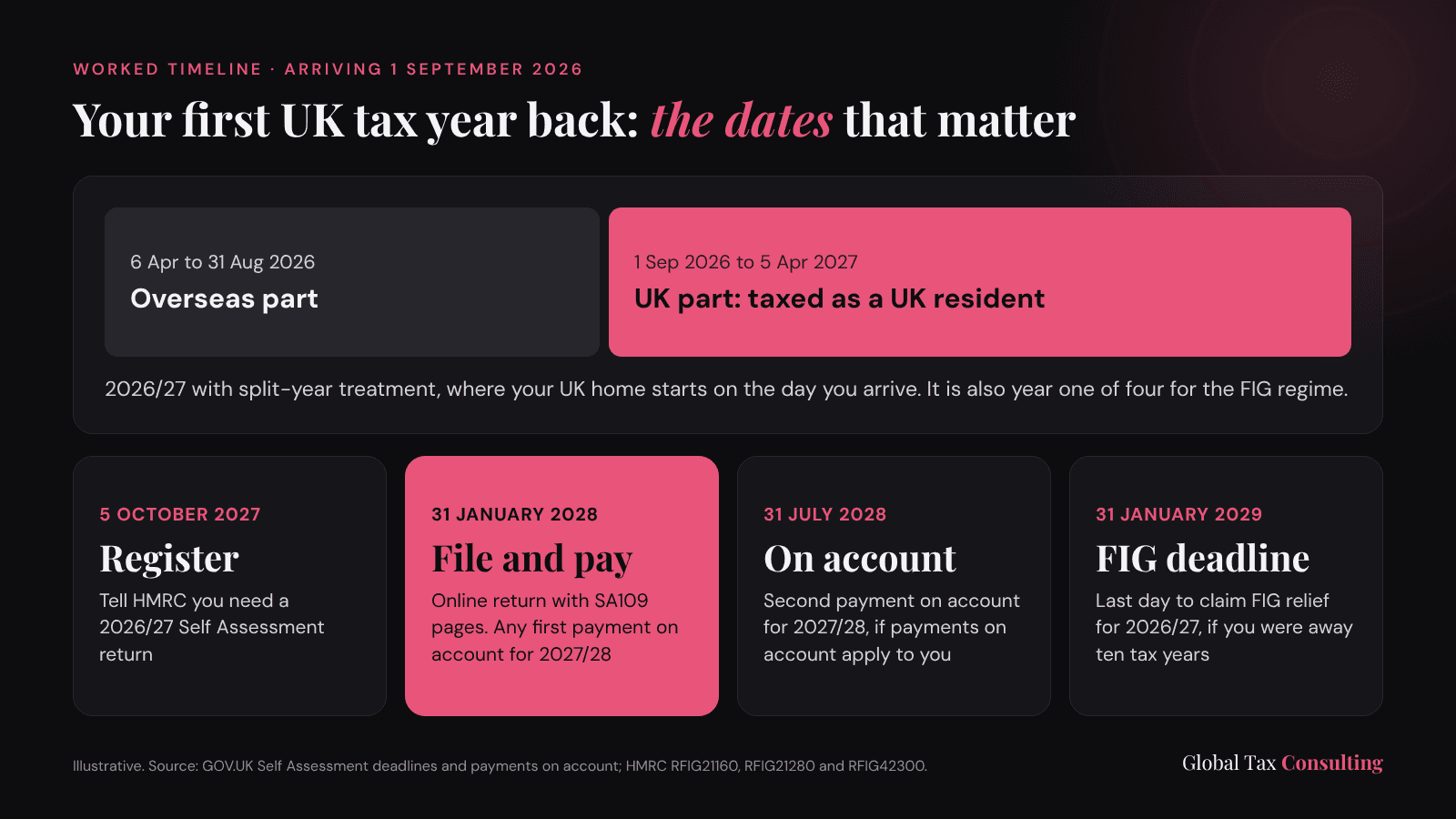
Image 2 — Key tax dates for someone arriving on 1 September 2026
Before you move: count your years away and plan your arrival date.
When you start work: with no P45, give your employer a starter checklist so they can work out your tax code.
By 5 October after the tax year: register for Self Assessment. For a 2026/27 arrival, that's 5 October 2027.
By 31 January: file online and pay, so 31 January 2028 for 2026/27. Payments on account can also fall due then and on 31 July.
The SA109 residence pages carry your arrival date, split-year case and FIG claims. HMRC's free online service can't file them, so you need commercial software or an adviser. See HMRC forms for expats. Sole traders and landlords with qualifying income over £20,000 in 2026/27 must use Making Tax Digital for Income Tax from 6 April 2028.
👉 GOV.UK: Tax if you return to the UK
Common mistakes when returning to the UK
Assuming residence starts when you land. Visits, a UK home or UK work earlier in the tax year can make you resident for the whole year.
Counting calendar years. The FIG test needs ten complete tax years of non-residence, and a split year counts as a UK year.
Selling after you arrive. The whole gain since purchase is taxable, not only the growth since you came back.
Forgetting what you did while away. Share sales, company dividends and pension withdrawals abroad can be taxed when you return.
Frequently asked questions
Do I pay UK tax on foreign income when I return to the UK?
Yes, from the date you become UK tax resident again. Residents are taxed on worldwide income and gains as they arise, wherever the money is kept. The exception is the four-year FIG regime, which needs ten tax years of non-residence.
What tax applies when returning to the UK after 5 years abroad?
After more than five years away, the temporary non-residence rule doesn't apply, so gains made on overseas assets while abroad stay outside UK tax. At five years or less, certain gains, close company dividends and pension withdrawals are taxed in the year you return.
Can British citizens returning to the UK claim the FIG regime?
Yes. The test looks only at residence, so a British citizen who was non-resident for at least ten consecutive tax years can claim for their first four tax years back.
When do I become UK tax resident again after living abroad?
When you meet the Statutory Residence Test for a tax year, for example by spending 183 days or more in the UK or having your only home here. Split-year treatment can limit the tax to the UK part of the year, which starts when a split-year case's conditions are met.
Do I need to tell HMRC I'm moving back to the UK?
If you have foreign income, gains, rental or self-employed income, register for Self Assessment by 5 October after the tax year you arrive in. With only a UK salary taxed under PAYE, you don't need to register.
work with GTC
Get your position confirmed in writing
Global Tax Consulting advises internationally mobile individuals on residency reviews, UK tax planning and tax return preparation. Tell us where you are and what you earn, and you will have a fixed fee and a clear view of your UK tax position.
⭐ 5★ rated